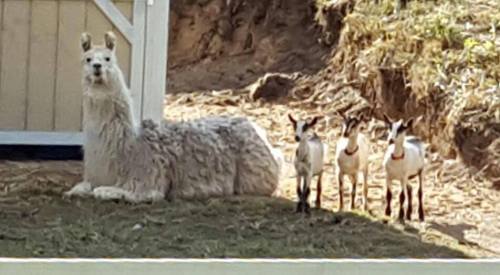
(Left to right) Dolly, Nettle, Buckwheat, and Alfalfa hanging out and enjoying the summer sun.
Having spent a fair amount of time on farms in the past, I’d lived with lots of different animals: horses (trained them), cows (a handful), chickens (lots), turkeys (as few as possible), rabbits (4-H), and dogs and cats.
But I’d never owned goats or llama. Till now.
This summer we added three weathers (i.e., neutered male goats) and a 2-year-old llama to our five acres — and I now have a few things to say about the crew:
Goats bring the party.
Full of opinions and bonhomie, these three are never boring. Triplets and miniature Alpines, they are tasked with eating down the blackberry bushes and other weeds. They are good at their job, but also, I’ve learned, committed to fun.
In fact, to combat goat boredom, we’ve created two playgrounds for them and continue to add to them. I spend an inordinate amount of time thinking of ways to entertain these perpetual puppies.
The boys have also settled into a loose hierarchy: Nettle is the spokesgoat, Buckwheat is the supervisor, and Alfalfa is the head of Dolly’s fan club.
This is a slightly different pecking order than earlier this summer. Alfalfa, the largest kid, was second in command, and Nettle the kid who’d get picked on. But after losing a horn in an unfortunate accident, Alfalfa was demoted. Thankfully, he’s still Dolly’s favorite and when a llama approves of you, you’re going to be OK.
Llamas make great chaperones.
Years ago, I wrote an article about hiking with llamas for a health magazine. During one of the interviews, I learned llamas will keep bear and other predators away from a camp. I wasn’t sure how exactly those camelids could do that, but I tucked that trivia away in my brain.
Once I bought this little farm, we regularly heard coyotes in the wee hours (and frequently saw them in the field during the day). If I intended to use goats for weed control, I’d need to get them a guard so prevent them becoming someone’s lunch.
And so Dolly (she came with the name, by the way) joined us first.
Llamas, I’ve discovered, are the cats of the livestock world. They don’t care about you really, but do accept your homage. On their terms.
The boys adore her and follow her across the pasture in parade formation. I have also seen her herd them back to the stalls when something in the woods (a lurking coyote?) causes her concern.
Originally owned by a retired nurse, Dolly next went to a family that raised miniature Angus. They didn’t much care for her, and didn’t do anything with her, so the poor girl was mostly left to her own devices. Not so with us. She’s rightfully spoiled, and I count as one of my great successes in life when she gave me a llama kiss.


 PawPrints Productions